
A Cot Bed Built to Grow Up: What's Inside Our Newly Tested Convertible Design
Oct 12, 2026
Anyone shopping for a cot is really shopping for two or three beds at once: the newborn months, the pulling-up months, and then the toddler who has decided cots are for babies. A convertible cot bed tries to cover all of that with one frame. The difficult part, from a factory's side, is making sure that promise holds up in testing and not just in the product photos.
In September 2026, one of our newest cot beds came back from Intertek with a pass against the European cot standard EN 716. This post walks through how the cot converts, what it is made from and how big it is, and what that test report actually covers - including the parts it deliberately leaves out, because a buyer reading a certificate should know exactly what it does and does not say.

Stage one: baby cot mode, with round corners and angled feet
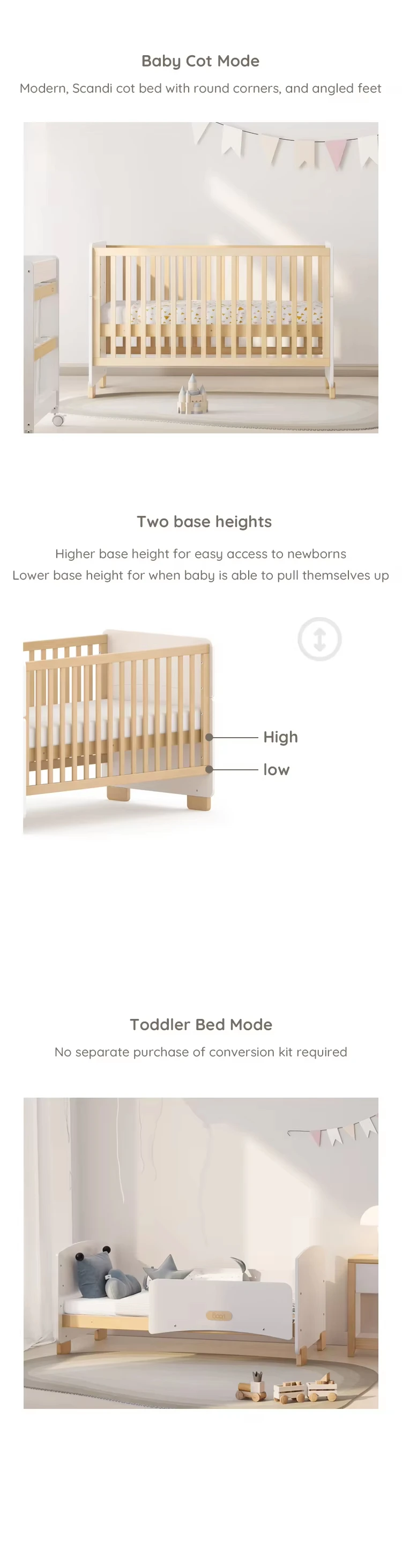
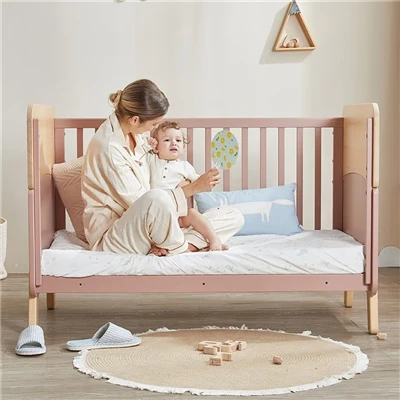
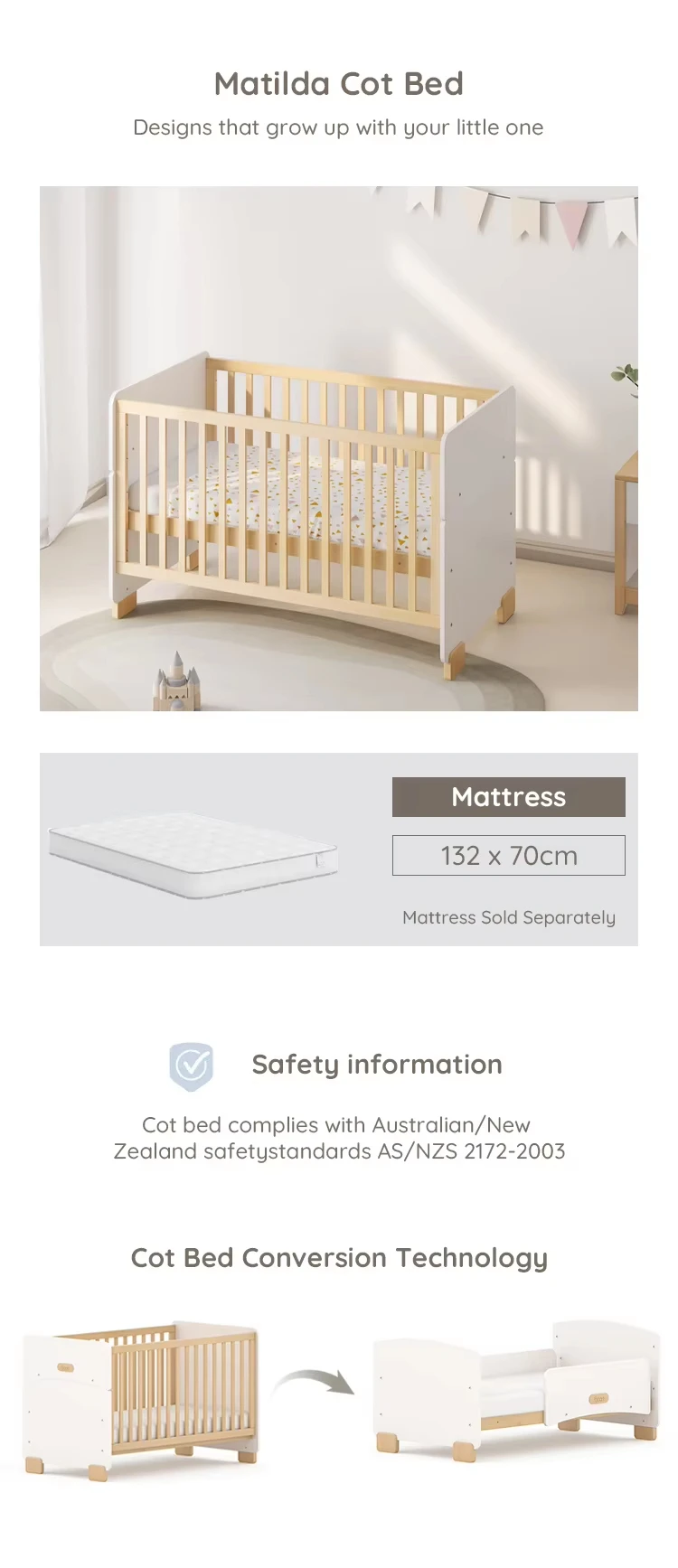
In its first configuration the cot is a classic slatted design with a modern, Scandinavian look: a pale timber frame, white end panels, round corners instead of square ones, and feet that angle outward rather than dropping straight to the floor. The rounded corners are as much practical as aesthetic. A baby who is starting to stand and grab will spend months with hands and head right at the height of the rails, so fewer hard points at that level is a sensible design goal.
The angled feet widen the footprint at floor level, which keeps the cot visually light while still giving it a stable base.
Two base heights for two very different months
The mattress base sits at one of two heights. The higher position is meant for newborns, when a parent is lifting a baby in and out many times a day and doesn't want to bend deep into the cot. Once the baby can pull up to standing, the base drops to the lower position, so the rails are tall enough relative to the mattress to do their job.
It is a small adjustment, but it is a good example of why a convertible cot is more than a cot with an extra part: the same frame has to behave correctly at both ends of the first few years.

Stage two: toddler bed mode, with no extra conversion kit
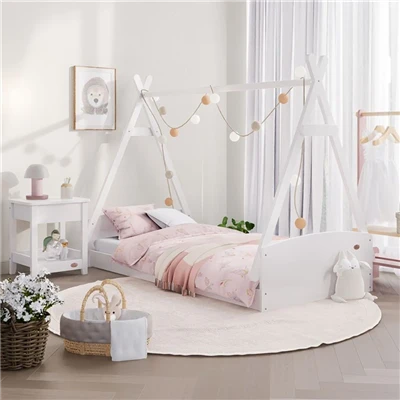
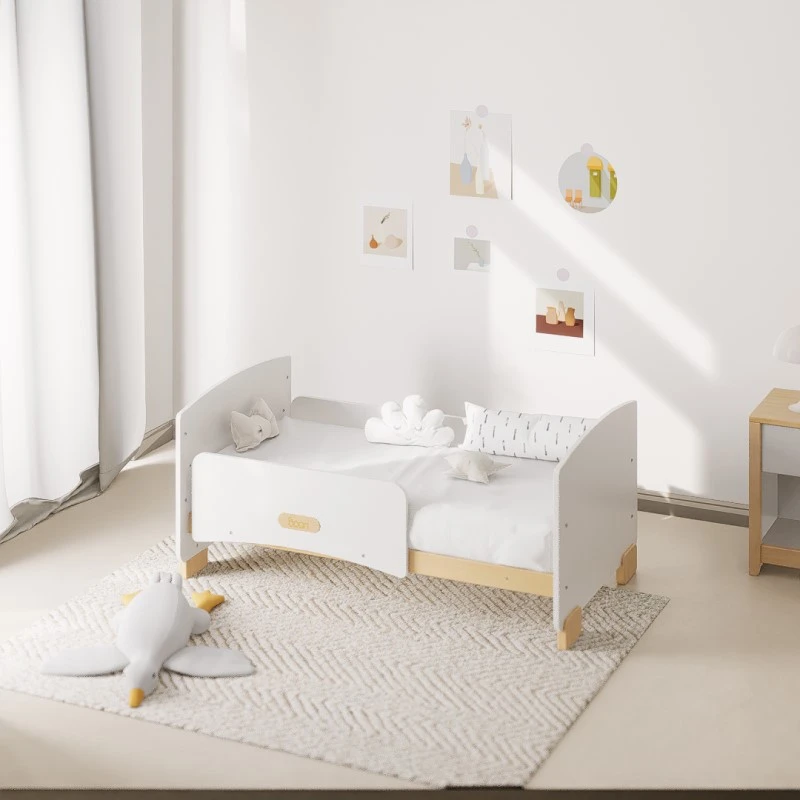
When the cot is outgrown, the slatted sides come off and the frame becomes a low toddler bed with a guard panel along the open side. No separate conversion kit has to be bought for this; the parts for the change come with the cot. The result is a low bed a small child can climb into alone, which is the point at which many families would otherwise be shopping for a second bed. For children who have moved beyond this stage, our toddler single bed range is the natural next step in the same low-frame style.
What it is made from, and how big it is
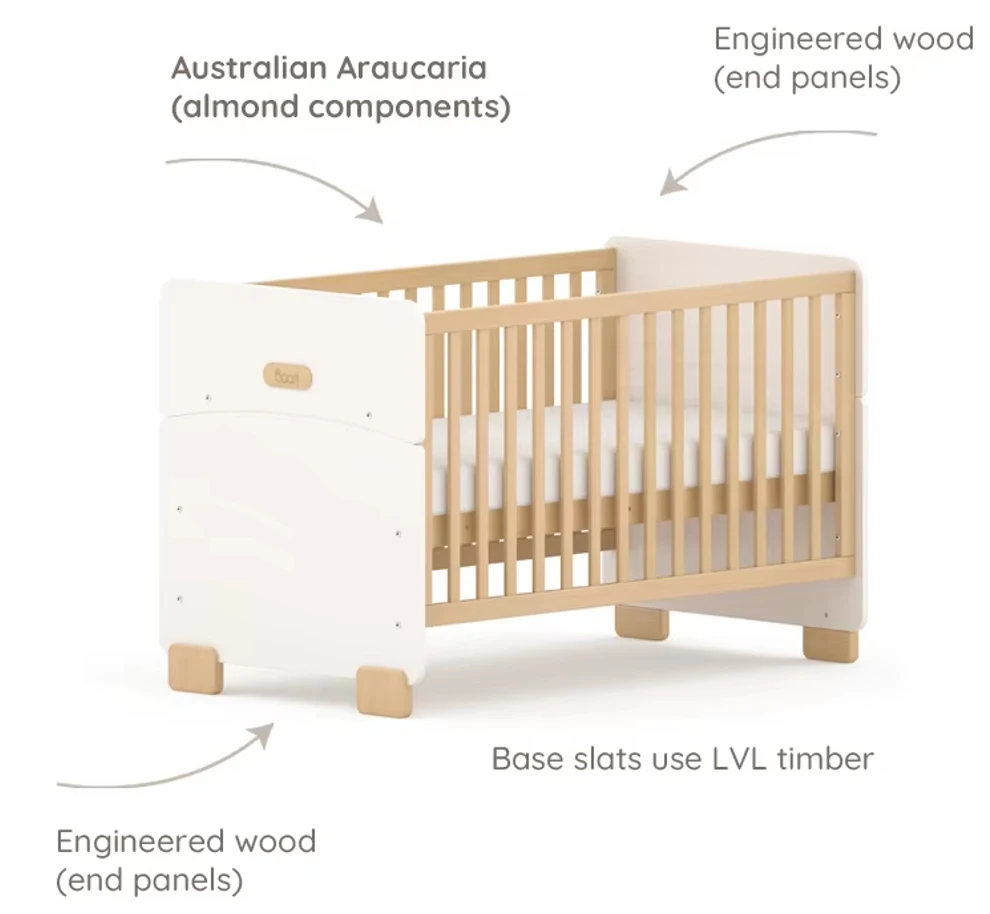
The natural-timber components of the cot are made from Australian Araucaria, the end panels are engineered wood, and the base slats are LVL (laminated veneer lumber). Each material has a job. Engineered wood is generally a good choice for large flat panels because it resists warping better than a single wide board, while LVL is built up from thin bonded layers so that load-bearing slats have consistent strength from piece to piece.
The assembled cot measures 138.7 cm long, 79.4 cm wide and 88 cm high, and takes a 132 × 70 cm mattress, which is sold separately. If you are pairing the cot with a mattress, confirm that size first; our cot bed pocket spring mattress range is the place to start looking.
The test report: what was tested and what passed
The cot was tested by Intertek under report number SHAH01986687, dated 22 September 2026. The testing period ran from 9 July to 22 September 2026, and the applicant on the report is Zhejiang Hanhao Industrial Co., Ltd. The standard is listed as EN 716-1-2:2017+AC:2019, Furniture – children's cots and folding cots for domestic use, and the result recorded is Pass.
The report also lists Europe, the U.S.A., Australia, New Zealand and Japan as the destination markets for this model. EN 716 is a European standard, so the pass speaks most directly to the European market; requirements in other countries differ, and we are happy to talk through what a specific market needs.

What the report covers, and what it leaves out
A certificate is only as useful as a buyer's understanding of its scope, so here is the fine print. The report states the tested clauses as EN 716-1-2:2017+AC:2019 excluding Clause 4.2.1, which covers materials and surfaces, and Clause 4.2.2, which covers the flammability of textiles, coated textiles and plastics coverings. In other words, this pass does not speak to those two areas, and a buyer whose market requires them should ask for that evidence separately.
The marking assessment is also worth reading closely. It is recorded as a pass, but the report notes that the labelling evaluation was based on the artwork submitted rather than on an actual labelled sample, and that checks such as letter height and print durability were not carried out on the sample. We would rather say that plainly than let a short summary imply more than the document does.
Built for distributors as much as for parents
Zhejiang Hanhao Industrial Co., Ltd has made wooden baby and children's furniture in Jiaxing, Zhejiang since 1993. Production runs across a 130,000+ sqm facility with 300+ machines and 200+ skilled workers, under ISO 9001:2015 and FSC certification. You can read more about the factory on our About Us page. Finish colors, panel shapes and packaging can be adjusted under OEM/ODM to fit an existing range, and a conversion design like this one is exactly where consistent production matters: the panels and fittings have to line up the same way on unit one and unit two thousand.
If you are comparing options, our convertible cot and infant cot pages show the rest of the cot range, and our team can share the test documentation and specification for this model on request.